
Top TBI Tech!
Summary: RightEye and Cognivue Clarity are our FDA-cleared tools used to determine cognitive function after a head injury. While they don’t diagnose concussions or TBI, they do provide objective physiological metrics that help guide clinical decision-making and track patient recovery.
Two FDA-cleared tools we use to determine cognitive function are RightEye and Cognivue Clarity.
These tools do not diagnose concussions or TBI, but they provide objective physiological metrics that help guide clinical decision-making and track patient recovery.
We wrote about traumatic brain injuries (TBIs) in depth back in March. That’s when we introduced you to immediate post-concussion assessment and cognitive testing (ImPACT®), Excelsia’s Post-concussion Assessment and Cognitive Testing program. ImPACT is time-sensitive; assessments should be conducted immediately after a person suffers a head injury. Why? First, it establishes a baseline from which to gauge treatment progress. Second, it helps doctors to determine the best course of treatment. And third, some cognitive impairments take longer to make themselves known to those who have suffered from head injuries, concussions, and TBIs.
RightEye
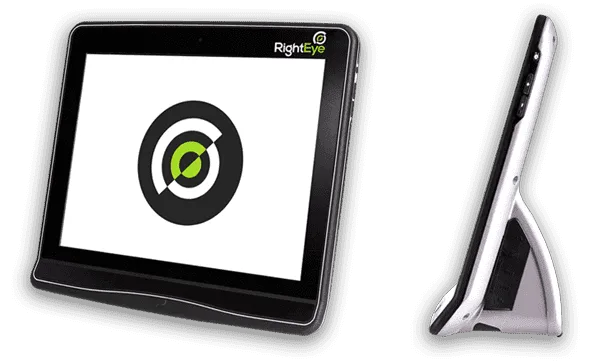
Objectivity counts in TBI assessments. While we always prioritize what a patient tells us is happening, RightEye allows us to objectively measure how the eyes and brain are working together during visual tasks.
What It Is
RightEye is an eye-tracking system that evaluates oculomotor function. Using non-invasive infrared tracking, it measures eye-movement behavior with millisecond precision. Because the oculomotor pathways are highly sensitive to neurological disruption, this information can help clinicians identify functional deficits following concussion or other neurological injuries.
What It Does
RightEye provides an objective of multiple oculomotor domains, including:
- Saccades (rapid movement of the eye between fixation points)
- Smooth pursuit (smooth tracking of a moving object)
- Fixation stability (ability to hold a steady gaze)
- Vergence (simultaneous pupil movement)
- Binocular coordination (seamless alignment of both eyes for unified perception)
The results reveal impairments that are often not detectable with standard vision tests. Although RightEye does not diagnose concussion, the data can support clinical findings, assist in identifying functional visual deficits, and help guide rehabilitation planning.
RightEye also includes vision training modules (e.g., Bubble Blast and related game-based exercises). These are designed to improve oculomotor control and visual processing speed through neuroplasticity. The therapy component is optional and used to reinforce rehabilitation goals.
Cognivue Clarity
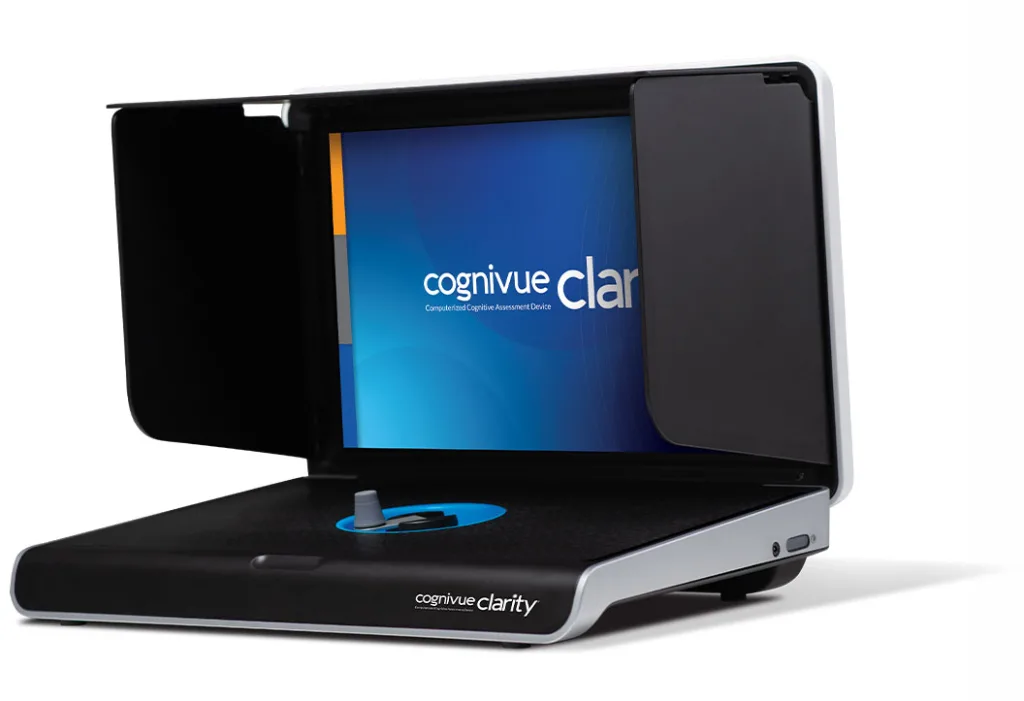
People who suffer head injuries may not notice decline right away. Objective screening helps clinicians detect changes early and track recovery over time.
What It Is
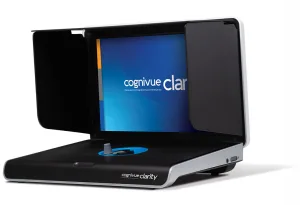
Cognivue Clarity is a computerized cognitive screening tool. It is not a diagnostic test for concussion, dementia, or neurological disease; instead, it provides a quick, reproducible assessment of cognitive domains commonly affected after brain injury.
What It Does
Cognivue Clarity measures:
- Processing speed
- Memory
- Executive function
- Visuospatial ability
- Reaction time
- Motor coordination
- Selective and divided attention
Its adaptive testing platform uses psychophysical principles to automatically adjust task difficulty based on patient performance, producing objective, standardized results that can be compared over time.
Cognivue Clarity is a screening instrument; it does not provide therapy. Its purpose is to:
- Detect subtle cognitive changes
- Support treatment planning
- Monitor functional improvement during recovery
Excelsia uses these tools in several of our locations across the country, now including St. Louis-Frontenac, MO. Want to know more? Talk with our team.